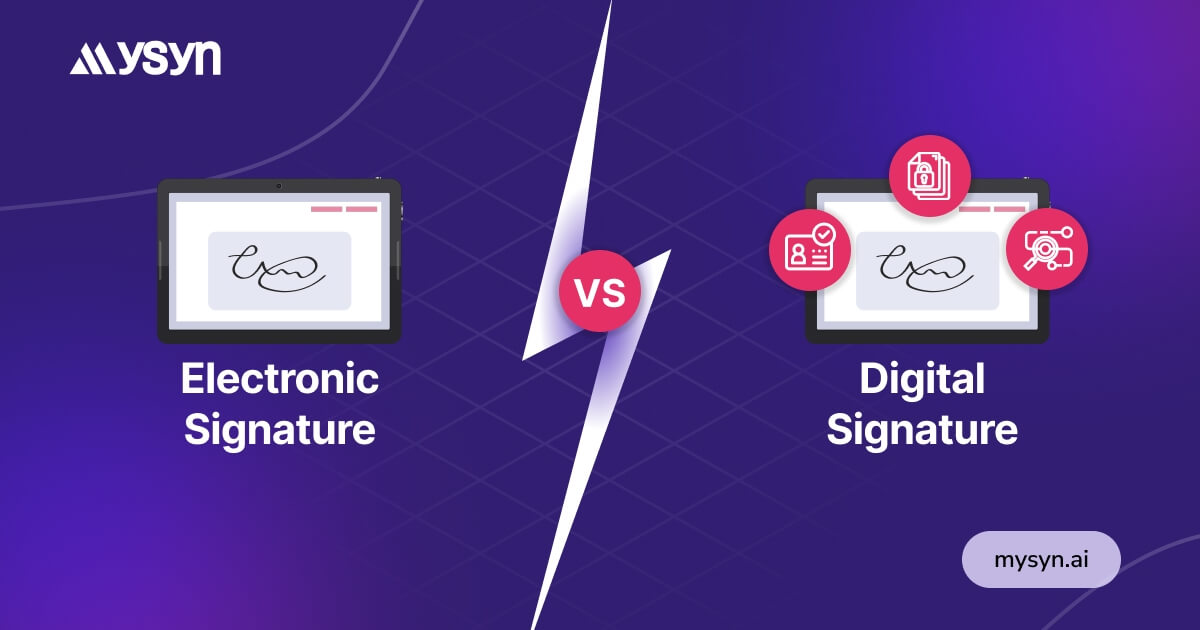
This is where many businesses get confused. The law recognises three types of electronic signatures, and choosing the wrong one could create problems if your contract is ever disputed in court.
Basic Electronic Signatures
This is the simplest form – think of clicking ‘I agree’ on a website, typing your name at the end of an email, or using a scanned image of your handwritten signature.
Legal status: These are valid, but there is a catch. If someone challenges the signature in court, you will need to prove that you actually signed it and that the document has not been changed since. For everyday internal documents and low-risk agreements, basic signatures work fine. For anything more important, you will want something stronger.
What makes it valid:
- Clear intent to sign (the person knew they were agreeing to something)
- Some form of electronic mark or process indicating agreement
- Connection to the document being signed
Advanced Electronic Signatures
These signatures use technology to create a unique digital mark that is tied specifically to you. They are designed so that only you can create them, they clearly identify you as the signer, and any changes to the document after signing are immediately detectable.
Legal status: Advanced signatures provide much stronger evidence in legal disputes. Courts give them more weight because they have built-in security features that prove authenticity.
What makes it valid:
- Uniquely linked to the signer
- Capable of identifying the signer
- Created using means the signer can maintain under their sole control
- Linked to the data signed in such a way that any subsequent changes are detectable
Appropriate for: Most business contracts, vendor agreements, employment documents, NDAs, and operational agreements.
Qualified Electronic Signatures
This type gets the highest level of security. Qualified signatures come from TDRA-licensed providers who verify your identity and issue you a secure certificate. Think of it as the digital equivalent of having your signature notarised.
Legal status: Courts automatically accept qualified signatures as authentic. You do not need additional evidence to prove you signed the document. The law treats them exactly like handwritten signatures.
What makes it valid:
All the requirements of an advanced signature, plus:
- Created using a qualified signature creation device
- Based on a qualified certificate issued by a licensed provider
- Meets technical standards set by TDRA regulations
Appropriate for: High-value contracts, regulated industries, government contracts, real estate transactions, or any agreement likely to face legal scrutiny.