The Legality of e-Signatures in Botswana: Law, Trust, and the Quiet Shift to Digital Agreements

Electronic signatures are legally recognised in Botswana – but validity alone is not enough. This article unpacks the legal framework, limitations, and growing demand for verifiable digital trust.

  • By Vani Sriranganayaki |
  •  •  14 min Read

Not to belabour the point, but there is a quiet shift underway in how agreements are made, executed, and enforced. Across industries and geography, ink, paper, and presence are being actively replaced by something more fluid – a click, a confirmation, and a much more reliable digital trace. In Botswana, this shift is not just technological. It is legal, deliberate, and increasingly consequential.

At the heart of this transformation lies a simple but powerful question: Can a signature still be trusted when it is no longer inked on paper?

Botswana’s legal framework answers this with clarity – yes, it can. But here again, conditions apply! The law does not grant blanket permission; it sets boundaries to ensure that authority is exercised responsibly, transparently, and in a way that safeguards public trust. The key lies in the underlying necessity that, even in digital form, the integrity of the process must be preserved and kept intact.

Legal Foundation for Electronic Signatures in Botswana

The legitimacy of electronic signatures in Botswana is rooted within the ‘Electronic Communications and Transactions Act, 2014 (ECTA) – a piece of legislation that signals the country’s intent to participate meaningfully in a digital economy. The Act established a foundational principle that feels almost deceptively simple: electronic communications and signatures ‘cannot be denied legal validity solely because they are electronic.’

This equivalence between digital and handwritten signatures is not merely symbolic. It enables:

  • Contracts to be executed electronically
  • Offers and acceptances to be communicated digitally
  • Agreements to be enforced without physical documentation

In effect, the law recognises that ‘form should not override intent.’

Yet, this recognition is not unconditional.

e-Signature Legality is not Automatic – It is Constructed

An electronic signature, under Botswana law, is more than a simple digital mark. It is defined to include the data that is attached to or associated with an electronic communication – data that identifies the signatory, signals their approval, and often even records their interaction with the document up to the moment of signing.

For such signatures to be considered valid and enforceable, it must meet a threshold of ‘reliability’. This includes:

  • A clear method to identify signatories
  • Evidence of the signatory’s intent and approval
  • Assurance that the signing process was under their control
  • Detectability of any post-signing alterations

What emerged here is a subtle but important distinction. The law does not prescribe ‘how’ signatures are created but is deeply concerned with ‘how trustworthy they are.’ This flexibility allows for innovation. But it also places responsibility on the systems that facilitate digital signing.

Electronic vs ‘Secure’ Electronic Signatures

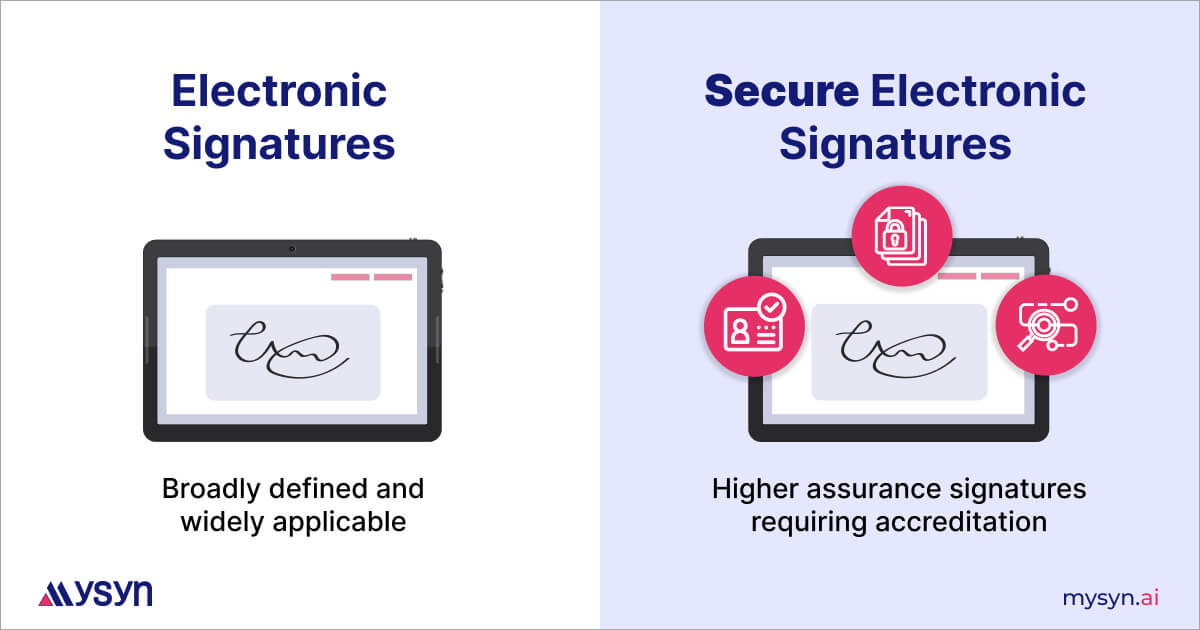
Botswana’s legal framework goes a step further by distinguishing between two types of signatures:

electronic signatures vs secure electronic signatures
 
Secure electronic signatures must be supported by providers who comply with the regulations put forth by the Botswana Communications Regulatory Authority (BOCRA). This distinction reflects a layered approach to trust. Not all transactions carry the same risk, and not all signatures need the same level of security and assurance.
In practical terms, this means that routine agreements may rely on standard electronic signatures, the likes of which are provided for free by several service providers online. But high value, or regulated transactions – those that involve the law. government, or industries operating with high security and consequence – may require secure signatures backed by secure and compliance driven infrastructure. The law, therefore, does not treat digital signing as binary. It treats it contextually and places ‘trust’ at the very centre of the discourse.

Where is the Line? Documents that Cannot be Digitally Signed in Botswana

Despite its progressive stance, the ECTA also sets clear boundaries on what can and cannot be executed electronically. Certain transactions remain excluded for now, including:

  • Creation and execution of Wills
  • Enforcement of indentures
  • Declaration of trust and power of attorney
  • Sale or transfer of immovable property

These exclusions are not arbitrary. They reflect areas where legal systems traditionally demand heightened scrutiny, physical witnessing, or formal registration processes. Yet even here the boundaries may not remain static forever.

Recent legislative developments in Botswana, particularly the Digital Services Act of 2025, suggest a significant shift in how digital transactions and secure signatures are regulated. While the ECTA of 2014 remains the core legal framework for electronic signatures, new initiatives under the SmartBots strategy are introducing updated standards for security and interoperability.

Evidence, Admissibility, and the Question of Proof in e-Signatures

Legal recognition alone is not enough. For any signature – digital or otherwise – the real test lies in its ability to stand up in court. Botswana addresses this through the Electronic Records (Evidence) Act, 2014, which governs the admissibility of electronic records.

Under this framework, electronic records are admissible as evidence, with courts evaluating their evidential weight based on integrity and reliability. The systems used to generate such records may also be subject to certification, ensuring that the process behind their creation is trustworthy. This introduces an important dimension to digital signing, where evidence is not merely about existence but about credibility.

A signature that cannot demonstrate:

  • when it was created
  • who created it
  • whether it has been altered

may satisfy form but it fails in substance.

What's the Legality of e-Signatures in Botswana?

Botswana’s approach to electronic signatures is both outward-looking and inwardly pragmatic. On the global stage, its law acknowledges that contracts rarely respect borders. By recognising electronic signatures created abroad – so long as they provide a ‘substantially equivalent level of reliability’ – Botswana enables cross‑border commerce while underscoring the importance of comparability over uniformity. The message is clear: credibility matters more than conformity.

But recognition is only half the story. Within Botswana, adoption unfolds in boardrooms, banks, procurement offices, and governance workflows, where trust – not statute – often dictates behaviour. Remote work and digital services have accelerated uptake, yet many organisations remain anchored in hybrid practices, balancing digital convenience with paper‑based assurance. This is not reluctance; it is risk management. Every electronic signature carries a silent question: Is this signature defensible if challenged?

By pairing international openness with domestic caution, Botswana’s framework reveals a deeper truth about e‑Signatures: legality provides the foundation, but credibility builds the bridge.

From Legal Validity to Verifiability: Shaping the Future of Digital Signing

Botswana’s legal framework sets the stage for a crucial evolution: moving beyond signatures that are merely valid toward signatures that are demonstrably verifiable. The distinction may seem subtle, but it is transformative. While a valid signature satisfies statutory requirements; a verifiable signature withstands scrutiny in the face of dispute. As transactions grow more complex and litigation more data‑driven, the burden increasingly falls on systems to prove identity with certainty, intent with clarity, and integrity without compromise.

This shift reframes the very meaning of a ‘signature.’ No longer a static act, it is becoming a multi‑layered process of authentication, validation, and recording. Botswana’s legislative groundwork positions the country well for this transition, but the trajectory will be shaped by how law and technology continue to interact. Certain trends are already emerging:

  • Increased reliance on identity verification mechanisms
  • Greater scrutiny of audit trails and transaction histories
  • Demand for tamper-proof and immutable records
  • Integration with broader digital governance frameworks

In this context, the future of e‑Signatures in Botswana will not be defined by legality alone, but by the strength of the evidence they produce. This is precisely where digital signature platforms like MySyn enter the picture. By embedding identity verification, maintaining detailed audit trails, and ensuring tamper‑proof records, MySyn exemplifies the shift from compliance to credibility. It treats signing not as a standalone act, but as part of a broader trust architecture – where every click is backed by evidence strong enough to endure challenges.

Conclusion: Trust Signs the Deal

The question concerning the legality of e-signatures in Botswana has long been settled. The law is clear, structured, and forward-looking, recognising them not as exceptions, but as integral to modern transactions. Yet, legality is only the threshold. The true test lies in trust.

A signature, digital or otherwise, is more than a mark – it is a declaration of intent, a promise captured in time. In the paper world, its authority simply rested on ink and presence. In the digital world, its authority rests on proof – proof of identity, proof of integrity, proof that it will stand unshaken when challenged.

Botswana’s digital journey will therefore not be defined by systems that merely enable signing, but by those that embed credibility into every click. Because, in the end, the strongest signature is not the one that exists – it is the one that endures.

Vani Sriranganayaki

Content Writer, elint AI

Writer, editor, and Head of Communications, Vani brings over a decade of expertise in publication and communication to explore the evolving world of technology. She crafts impactful narratives at the intersection of legal innovation and tech, championing progress. Reach her at vani.s@elint.in.